

Top-Rated Multi-Type Collagen for Muscle Mass in 2026
Table of Contents
- Why Multi-Type Collagen Matters for Muscle Mass in 2026
- Collagen and Whey Protein Benefits: A Complete Protein Approach
- How to Maintain Muscle Mass While Dieting
- The Importance of Amino Acids for Muscle Recovery
- How to Choose a High-Quality Collagen Powder
- Multi-Type Collagen and Joint Comfort During Intense Training
- Conclusion: Making Multi-Type Collagen Work for Your Goals
- Frequently Asked Questions
Last Updated: October 4, 2026
Why Multi-Type Collagen Matters for Muscle Mass in 2026
If you are trying to maintain muscle mass while losing weight, the type of protein you choose matters more than most diet plans admit. At OnHealth Nutrition, we hear the same question constantly: does collagen actually help, or is it just hype?
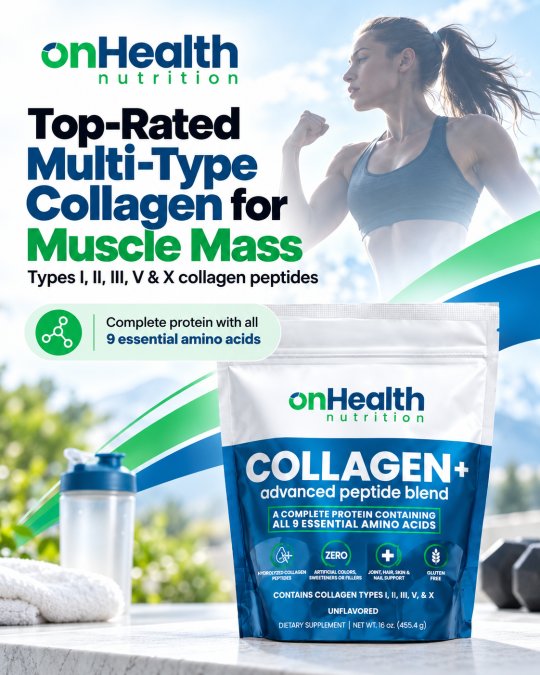
onHealth Collagen+
Here is the honest answer. Collagen on its own is an incomplete protein. It is low in tryptophan, one of the essential amino acids your body needs to build and repair muscle.
Most guides treat collagen as a beauty-only supplement. That framing is outdated. If you are dieting, you are eating less overall, which means every gram of protein has to work harder.
Collagen and Whey Protein Benefits: A Complete Protein Approach
Collagen and whey protein benefits stack in a way that neither delivers alone. Whey supplies all nine essential amino acids, including the leucine that triggers muscle protein synthesis. Collagen supplies glycine, proline, and hydroxyproline, the building blocks for connective tissue, skin, and joints.
Think of it this way: whey feeds your muscles, collagen feeds your structure. When you are in a calorie deficit, your body is more likely to break down muscle for energy. A complete protein source helps offset that. Collagen's amino acid profile alone cannot do it, but a blend can.
What most guides miss is that collagen peptides are hydrolyzed, meaning they are already broken into small peptides that absorb quickly. That is a real advantage when you want protein to reach your system without heavy digestion.
How to Maintain Muscle Mass While Dieting
The short answer: eat enough protein, lift weights, and do not cut calories so aggressively that your body breaks down muscle for fuel.
Protein first, and enough of it. A common pattern among women in a deficit is under-eating protein without realizing it.
Resistance training, not just cardio. Two to three full-body sessions per week is enough to signal your body to hold onto muscle. Cardio burns calories, but it does not send the same 'keep this tissue' message that lifting does.
A moderate deficit, not a crash diet. A slow, steady loss protects lean body mass better than steep restriction. Aggressive cuts tend to pull weight off from muscle as well as fat, which is the opposite of what you want if your goal is a leaner, stronger shape.
The caloric impact of collagen in a deficit
This is the piece most guides skip, and it matters if you are counting calories. A collagen-and-whey blend is food, not a free add-on. A typical scoop contributes protein and calories to your day, so it belongs in your total intake, not on top of it.
Here is how to think about it in practice:
- Count it as protein, not as a treat. If your daily target is 130 grams of protein, a scoop that delivers a meaningful chunk of that is doing real work, it is not a garnish.
- Use it to replace, not add. Swap it for a lower-protein snack (a handful of crackers, a pastry) rather than stacking it on top of a full day of eating. That keeps your total calories steady while your protein goes up.
- Watch the liquid calories. Blending a scoop into a smoothie with juice, honey, and banana can quietly turn a protein boost into a dessert. Water, unsweetened milk, or black coffee keeps the calorie math simple.
- Time it where hunger hits. The mid-afternoon slump is when most diets fall apart. A scoop at 3 p.m. often does more for adherence than a scoop at 7 a.m.
Protein also tends to be more satiating than fat or carbohydrate, so a higher-protein day often makes a deficit easier to stick with. That is a practical benefit worth naming: the goal is not just to protect muscle, it is to make the diet livable enough that you actually stay on it.
If you take medication or manage a health condition, talk with your healthcare provider before adding a new supplement to your routine.
The Importance of Amino Acids for Muscle Recovery
The importance of amino acids for muscle recovery comes down to a simple idea: your muscles are built from amino acids, and after training they need a specific set of them to repair microtears and rebuild. Not all amino acids are equal for this job, and that is where the collagen conversation gets interesting.
The leucine trigger
Leucine is the amino acid that flips the switch on muscle protein synthesis, the process your body uses to build and repair muscle. Think of leucine as the key and the other amino acids as the building materials. Without enough leucine in a meal or shake, the door stays shut and the materials sit unused. Whey is naturally high in leucine, which is one reason it has long been a staple for people trying to hold onto muscle.
Collagen, on its own, is a poor leucine source. It is also low in tryptophan, another essential amino acid. That is the honest limitation of collagen as a standalone muscle supplement, and it is worth saying plainly rather than glossing over. Collagen is not a complete protein.
What collagen brings to recovery
Collagen's contribution is different but complementary. It is rich in glycine, proline, and hydroxyproline, the amino acids your body uses to build connective tissue like tendons, ligaments, and cartilage. Those structures take a beating during strength training and recover more slowly than muscle does. Glycine also plays a role in sleep quality and in the body's own collagen production, both of which matter when you are training hard and eating less.
So the two work on different timelines: whey supports the muscle you are trying to keep, and collagen supports the scaffolding that lets you keep training.
Synergistic pairing: how to stack for a stronger effect
Most articles treat collagen as a solo act. The better approach is to pair it deliberately:
- Collagen plus a leucine-rich complete protein. This is the core stack. Whey is the most common choice because it is high in leucine and absorbs quickly. Together, you get the trigger (leucine) and the building blocks (the full essential amino acid profile) in one serving.
- Collagen plus vitamin C. Vitamin C is a cofactor your body uses when it builds collagen. Pairing collagen with a source of vitamin C, citrus, berries, bell peppers, or a supplement, is a common practice among people who take collagen for skin and joint support.
- Collagen plus resistance training. Amino acids alone do not build or preserve muscle. The training stimulus is what tells your body to use them. A shake without a training habit is a missed opportunity.
- Collagen plus adequate total protein. A scoop is a contributor, not the whole plan. If the rest of your day is low in protein, one shake will not close the gap.
Timing, in plain terms
The old idea of a narrow 30-minute 'anabolic window' has softened. What most practitioners find is that total daily protein matters more than split-second timing, but a complete protein within a couple of hours of training is still a sensible habit. Pairing that with collagen means you are supporting both the muscle and the connective tissue that holds it in place.
If you take medication or manage a health condition, talk with your healthcare provider before starting a new supplement.
How to Choose a High-Quality Collagen Powder
Knowing how to choose a high-quality collagen powder saves you from wasting money on products that never reach your joints or skin. Use this checklist before you buy:
- Does the label list the specific collagen types, not just "collagen"?
- Does it name its source, such as bovine hide or marine collagen?
- Is the amino acid profile disclosed, including glycine and proline amounts?
- Is the serving size realistic for daily use?
What to Check |
Why It Matters |
Red Flag |
|---|---|---|
Collagen types listed |
Multi-type formulas cover more needs |
Vague "collagen blend" |
Amino acid profile |
Shows glycine and proline content |
Undisclosed profile |
Talk with your healthcare provider before starting any new supplement, especially if you take medication or manage a health condition.
Multi-Type Collagen and Joint Comfort During Intense Training
Joint comfort during intense training is where collagen earns real attention. Tendons and ligaments are made largely of collagen, and they recover more slowly than muscle. When you train hard and eat less, those tissues get less support, which is why so many women notice stiff knees and achy shoulders during a weight loss phase.
A multi-type collagen that includes type I and III collagen supports connective tissue, while type II is concentrated in cartilage. Hydrolyzed collagen peptides are small enough to absorb efficiently, so the amino acids reach the tissues that need them. This is not a quick fix, and it is not a pain reliever.
If you strength train, think of collagen as part of your recovery stack alongside protein, sleep, and hydration. Consistency over weeks and months is what makes the difference, not a single scoop.
Conclusion: Making Multi-Type Collagen Work for Your Goals
Protecting muscle while losing weight takes more than cutting calories. It takes complete protein, resistance training, and connective tissue support working together. Collagen+ from OnHealth Nutrition combines five types of collagen with whey for a complete protein formula, delivering a high concentration of glycine, proline, and hydroxyproline to support skin health, joint health, and total body vitality. It comes in a convenient pouch with 33 servings that mixes easily into your daily routine. Shop Collagen+ and give your body the support it needs while you work toward your goals.
These statements have not been evaluated by the Food and Drug Administration. This product is not intended to diagnose, treat, cure, or prevent any disease.
Frequently Asked Questions
Does multi-type collagen help with muscle maintenance during weight loss?
Multi-type collagen can support muscle maintenance when it provides complete protein. Collagen alone lacks tryptophan, so it is not a complete protein. A formula that combines collagen with whey delivers all essential amino acids, which supports muscle protein synthesis while you are in a calorie deficit. Pair it with strength training and adequate daily protein for the best support.
What is the difference between single-type and multi-type collagen?
Single-type collagen contains only one collagen type, usually type I or type II. Multi-type collagen includes several types, such as types I, II, III, IV, and V. Different types are found in different tissues: type I and III in skin and bone, type II in cartilage, and types IV and V in other connective tissues. A multi-type formula is designed to support more of your body's collagen needs at once.
How much protein do I need to maintain muscle while losing weight?
Research generally suggests aiming for 1.2 to 1.6 grams of protein per kilogram of body weight daily while dieting, though individual needs vary. A complete protein collagen supplement can help you reach that target, especially if you struggle to get enough from food alone. Talk to your healthcare provider or a registered dietitian to find the right amount for your body and goals.
Can collagen supplements support joint health during intense workouts?
Collagen provides glycine, proline, and hydroxyproline, which are amino acids used in connective tissue. Some research suggests collagen supplementation may support joint comfort and tendon integrity, particularly when paired with vitamin C and taken before activity. If you train intensely, a multi-type collagen with a complete amino acid profile can be part of a joint-support routine. Check with your healthcare provider before starting any new supplement.